How Can a Security Guard Company in Los Angeles, CA Protect Medical Buildings?
A security guard company in Los Angeles, CA can protect medical buildings by controlling access, monitoring entrances and waiting areas, conducting patrols, responding to security incidents, supporting workplace violence prevention procedures, and maintaining communication with medical staff and emergency responders. Depending on the facility’s needs, services may include armed or unarmed guards, mobile patrol, vehicle patrol, and firewatch.
Key Takeaways
- Security guards can monitor medical building entrances and exits.
- Access control helps limit unauthorized entry into restricted areas.
- Patrols can cover parking lots, hallways, and exterior areas.
- Guards can support emergency and workplace violence procedures.
- Security coverage can be customized for hospitals, clinics, and medical offices.
Why Do Medical Buildings Need Professional Security?
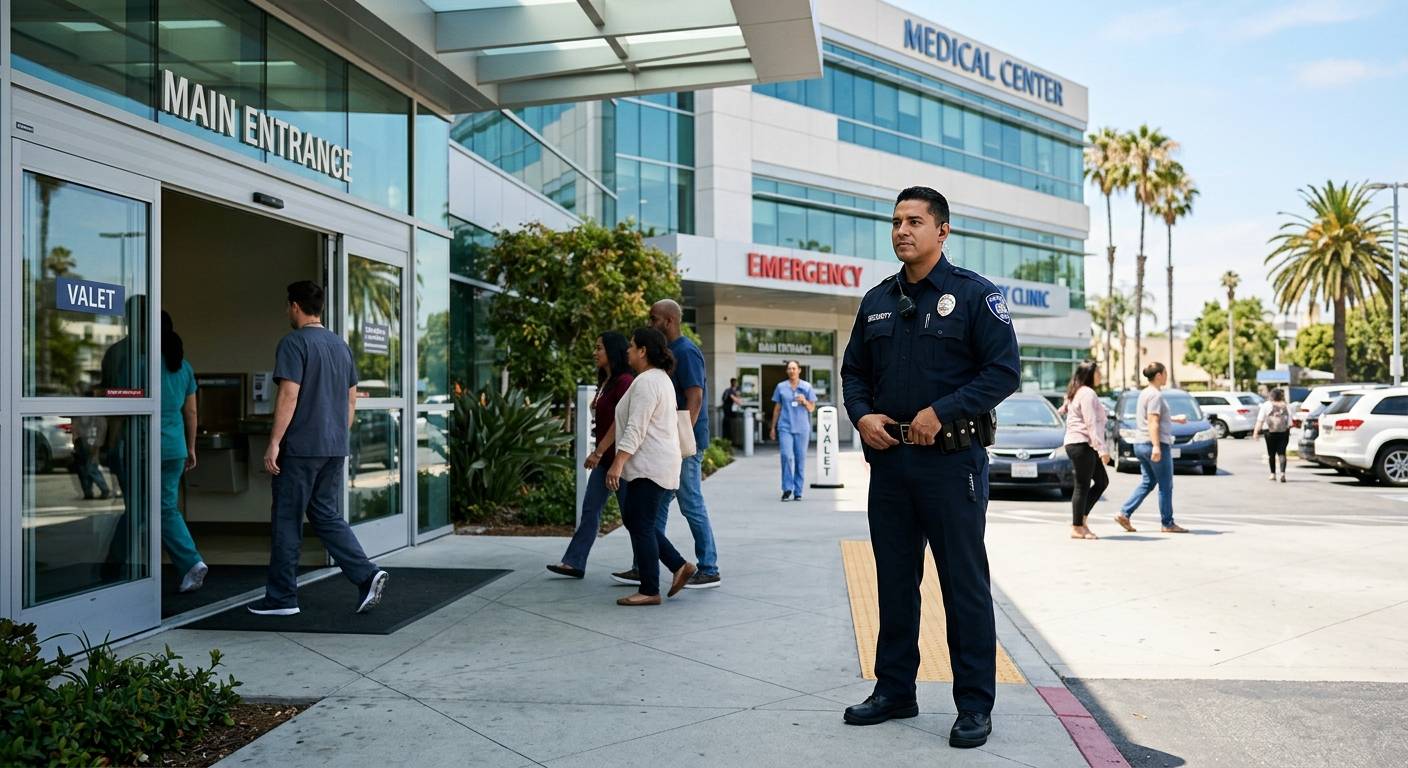
Medical buildings have security requirements that differ from ordinary commercial properties. Patients, visitors, physicians, nurses, administrative employees, contractors, and emergency personnel may enter the same facility throughout the day. Some healthcare environments may also involve patients experiencing distress, confusion, behavioral changes, or other circumstances that can increase security concerns. California’s workplace violence prevention standard for healthcare specifically addresses risks involving patients, visitors, employees, and other individuals. It also identifies dedicated safety personnel, including security guards, as a possible work-practice control. For medical properties in Los Angeles, Woodland Hills, Encino, Sherman Oaks, Van Nuys, Tarzana, and nearby communities, a structured security program can help facility management address these risks while maintaining a professional environment.
How Can Security Guards Protect Medical Buildings?
1. Control Building Access
A security guard company in Los Angeles, CA can assign officers to primary entrances, emergency entrances, employee access points, and other designated areas.
Guards may:
- Monitor visitors and vendors
- Check identification when facility procedures require it.
- Direct visitors to appropriate areas
- Monitor restricted entrances
- Report unauthorized access attempts.
- Help maintain controlled access during sensitive situations.
Access control is particularly important for areas such as pharmacies, administrative offices, patient units, equipment rooms, and other restricted spaces.
2. Monitor Waiting Areas and Public Spaces
Medical buildings can experience heavy visitor traffic, especially during peak appointment hours. Security officers can monitor lobbies, reception areas, hallways, and other public spaces for unusual behavior or security concerns. A visible officer can also serve as a clear point of contact when visitors need help locating an entrance, department, or waiting area.
3. Conduct Foot, Mobile, and Vehicle Patrols
Medical property protection should extend beyond the main lobby.
Mobile patrol and vehicle patrol can cover:
- Employee parking areas
- Patient parking lots
- Building perimeters
- Service entrances
- Loading zones
- Exterior walkways
- Remote sections of the property
California’s healthcare workplace violence standard specifically requires covered employers to assess environmental risks, including surrounding areas such as employee parking and outdoor areas. For facilities around Encino and Woodland Hills, patrol routes can focus on building entrances, parking areas, and other locations identified in the property’s security assessment.
4. Support Workplace Violence Prevention
Medical facilities need procedures for responding to potential workplace violence. California’s healthcare standard requires covered employers to maintain a workplace violence prevention plan and address workplace violence hazards, response procedures, training, and security measures. Security personnel can support these procedures by:
- Responding to security alerts
- Communicating with designated facility staff
- Monitoring high-risk areas
- Reporting incidents
- Helping maintain order during disturbances
- Contacting law enforcement or emergency services when required
A security guard company in Los Angeles, CA should coordinate its procedures with the medical facility’s established emergency and workplace violence plan rather than operate independently of facility protocols.
5. Provide Armed or Unarmed Security
Different medical buildings have different risk profiles. Unarmed security guards may be appropriate for clinics, outpatient facilities, medical offices, and properties primarily requiring access control, patrols, visitor assistance, and incident reporting. Consider armed security guards for facilities with elevated security concerns or specific protection requirements, subject to applicable California requirements. California’s BSIS requires security guards to meet registration requirements, including a criminal history background check and required training.
6. Provide Firewatch and Emergency Monitoring
Medical buildings rely on functioning safety systems and established emergency procedures. When specific circumstances require dedicated fire monitoring, firewatch security services can provide personnel to observe designated areas, identify potential hazards, communicate concerns, and follow the facility’s emergency plan. This service can be particularly relevant during construction, maintenance, renovations, or situations involving temporarily impaired fire-protection systems, subject to applicable requirements.
Why Medical Buildings Benefit From a Customized Security Plan
A healthcare security plan should account for the building’s size, patient population, operating hours, entrances, parking areas, restricted spaces, staffing patterns, and previous security incidents. Cal/OSHA guidance emphasizes worksite analysis, hazard prevention, engineering and administrative controls, education, training, and recordkeeping as components of healthcare security and safety programs. A security guard company in Los Angeles, CA can work with facility management to establish patrol schedules, access procedures, reporting processes, emergency communication methods, and post orders based on the property’s specific requirements.
Medical buildings are only one type of property that may require continuous security coverage. Read more about "How Can Security Guards Protect Vacant and Unoccupied Properties in Los Angeles?" improve property protection, including access control, overnight monitoring, mobile patrol, vehicle patrol, and firewatch services for commercial and residential properties.
FAQs
1. What security services can medical buildings use?
Medical buildings may use unarmed or armed security, access control, foot patrol, mobile patrol, vehicle patrol, visitor monitoring, and firewatch based on their specific security requirements.
2. Can security guards monitor medical building entrances?
Yes. Security officers can monitor designated entrances, control access according to facility procedures, assist visitors, and report unauthorized entry attempts.
3. Can guards patrol medical facility parking lots?
Yes. Foot, mobile, and vehicle patrols can cover patient and employee parking areas, exterior walkways, loading zones, and building perimeters.
4. Do California healthcare facilities have workplace violence requirements?
Yes. Covered healthcare employers must comply with California’s workplace violence prevention requirements, including a written prevention plan, training, incident documentation, and other applicable measures.
5. Can security guards respond to emergencies?
Security officers can follow the facility’s emergency response procedures, communicate with designated personnel, provide appropriate assistance within their authority, and contact law enforcement or emergency responders when necessary.
